what do personality theorists seek to accomplish in their role of scientists?
What is Personality?
Personality can be defined as those inner psychological characteristics that both determine and reverberate how a person think and act in an environment.
The inner characteristics of personality are specific qualities, attributes, traits, factors and mannerism that distinguish one individual from other individuals. Personalities are probable to influence the individual'due south product and store choices. They also affect the way consumer responds to a business firm'southward advice efforts.
Table of Contents
- one What is Personality?
- ii Personality Pregnant
- 3 Personality Definition
- four Personality in Organisational Behavior (OB)
- 5 Determinants of Personality
- 5.ane Biological Factors
- 5.1.ane Heredity
- 5.1.2 Brain
- five.1.3 Biofeedback
- 5.1.4 Physical Features
- v.2 Cultural Factors
- five.three Family Factors
- v.4 Social Factors
- five.5 Situational Factors
- 5.ane Biological Factors
- 6 Personality Characteristics
- 6.1 Locus of Control
- 6.ii Self-Efficacy
- 6.3 Self-Esteem
- six.iv Self-Monitoring
- six.5 Positive/Negative Bear upon
- 6.6 Risk-Taking
- 6.7 Type A and Blazon B Personality
- 7 Theories of Personality
- seven.1 Psychoanalytic Theory
- 7.2 Type Theories
- seven.3 Trait Theories
- seven.four Self-theory
- 8 Nature of Personality
- 8.1 Totality of Acts
- 8.two Personality and Surroundings
- 8.three Personality Depicts consistency
- 8.4 Personality is goal-oriented beliefs
- viii.5 Time Integrating structure
- 8.six Personality Structure
- 9 Brand Personality
- 9.1 Sincerity of the make
- 9.two Excitement
- 9.three Competence
- nine.4 Sophisticated
- 9.5 Rugged
- 10 Personality in Consumer Behaviour
- 10.1 Optimal Stimulation Level
- ten.2 Demand for Cognition
- x.3 Dogmatism
- 10.iv Susceptibility to Influence
- 10.five Self-monitoring Behaviour
Personality is a pattern of stable states and characteristics of a person that influences his or her behaviour toward goal achievement. Each person has unique ways of protecting these states.
Personality is the central and foremost determinant of individual behaviour. Information technology seeks to integrate the physiological and psychological facets of an individual to put them into activity. Personality consists of an individual's characteristics and distinctive ways of behaviour.
Probably the most meaningful approach would be to include both the person and the role as Floyd L Ruch does in his definition. He states that:
Human personality includes:
- External appearance and behaviour or social stimulus value.
- Inner awareness of cocky equally a permanent organising force.
- The detail pattern or organisation of measurable traits, both "inner and "outer".
Personality Meaning
The give-and-take personality is derived from a Greek discussion "persona" which means "to speak through". Personality is the combination of characteristics or qualities that forms a person's unique identity.
It signifies the role which a person plays in public. Every individual has a unique, personal and major determinant of his beliefs that defines his/her personality.
Personality Definition
Personality Definition by Authors: No common definition of personality has so far been arrived at. Every private defines personality in a different way which includes trait factors and physical appearance.
The dynamic organisation within the private of those psychophysical systems that determine his unique adjustments to his surroundGordon Allport
Personality is a broad, amorphous designation relating to key approaches of persons to others and themselves. To most psychologists and students of behaviour, this term refers to the study of the characteristic traits of an individual, relationships betwixt these traits and the manner in which a person adjusts to other people and situationsJ.B Kolasa
Personality is a very diverse and complex psychological concept. The word 'personality' may mean something like outgoing, invigorating interpersonal abilities … but nosotros must also recognize and explain the fact that evolution results in human acquiring a distinctiveness or uniqueness which gives him identity which enables him and usa to recognize him as autonomously from others. These distinguishing characteristics are summarized past the term 'personalityJames D Thompson and Donald Van Houten
Personality is how people impact others and how they sympathize and view themselves, too equally their pattern of inner and outer measurable traits and the person situation interactionFred Luthans
every bit the well-nigh adequate conceptualisation of an individual's behaviour in all its details which the scientist tin provide at a moment of timeMcClelland
Also Read: What is Organizational Behavior?
Personality in Organisational Behavior (OB)
Personality in Organisational Beliefs of an individual plays an extremely of import role in assessing the behaviour of a person at an organisation.
In instance an individual who is holding a senior position in an organization has a wrong type of personality, it may pb to a very bad impact on the relationship and ultimately it may lead to protests and unrest at the workplace.
Sometimes the personality difficulties are the root cause of labour strikes. No matter how good the superior is in technical noesis or other behavioural characteristics, information technology is the 'temperament' of the superior that is crucial in ensuring a cordial interaction with subordinates. Many businesses accept realized the importance of leadership in an organisation in shaping the personality of employees
Determinants of Personality
The determinants of personality tin can be grouped in five broad categories:
- Biological Factors
- Cultural Factors
- Family Factors
- Social Factors
- Situational Factors

Biological Factors
The report of the biological contributions to personality may be studied under iii heads:
Heredity
Heredity refers to those factors that were determined at formulation. Physical stature, facial attractiveness, sexual practice, temperament, muscle composition and reflexes, free energy level, and biological rhythms are characteristics that are considered to exist inherent from one's parents.
The heredity approach argues that the ultimate explanation of an individual's personality is the molecular construction of the genes, located in the chromosomes.
Brain
The second biological approach is to concentrate on the part that the encephalon plays in personality. The psychologists are unable to prove empirically the contribution of the human brain in influencing personality.
Preliminary results from the electrical stimulation of the brain (ESB) research give an indication that a better understanding of human personality and behaviour might come from the written report of the encephalon.
Biofeedback
Until recently, physiologists and psychologists felt that certain biological functions such equally brainwave patterns, gastric and hormonal secretions, and fluctuations in claret pressure and skin temperature were across witting control.
At present some scientists believe that these involuntary functions can be consciously controlled through biofeedback techniques. In BFT, the individual learns the internal rhythms of a item body process through electronic signals that are feedback from equipment that is wired to the torso.
Physical Features
A vital ingredient of the personality, an individual's external appearance, is biologically determined. The fact that a person is alpine or short, fatty or skinny, black or white will influence the person'due south event on others and this in plow, will affect the self-concept.
Cultural Factors
Amidst the factors that influence personality formation is the civilisation in which we are raised, early on workout, norms prevailing inside the family, friends and social groups and other miscellaneous experiences that touch on the states.
The culture largely determines attitudes towards independence, aggression, contest, cooperation and a host of other human responses.
Co-ordinate to Paul H Mussen, "each civilization expects, and trains, its members to behave in ways that are acceptable to the grouping. To a marked caste, the child'south cultural grouping defines the range of experiences and situations he is likely to encounter and the values and personality characteristics that will be reinforced and hence learned."
Family Factors
Whereas the culture generally prescribes and limits what a person tin be taught, it is the family, and later the social grouping, which selects, interprets and dispenses the culture. Thus, the family probably has the most significant impact on early personality development.
A substantial amount of empirical evidence indicates that the overall home environment created by the parents, in improver to their direct influence, is disquisitional to personality development.
The parents play an especially of import part in the identification procedure, which is important to the person's early development.
According to Mischel, the process can exist examined from iii different perspectives.
- Identification can be viewed every bit the similarity of behaviour including feelings and attitudes between kid and model.
- Identification tin can be looked at as the child's motives or desires to be like the model.
- Information technology can exist viewed every bit the process through which the child really takes on the attributes of the model.
From all three perspectives, the identification process is cardinal to the understanding of personality development. The home environs also influences the personality of an individual. Siblings (brothers and sisters) also contribute to personality.
There is increasing recognition given to the role of other relevant persons, groups and specially organisations, which profoundly influence an individual's personality. This is unremarkably called the socialization process.
Socialization involves the procedure by which a person acquires, from the enormously wide range of behavioural potentialities that are open to him or her, those that are ultimately synthesized and absorbed.
Socialization starts with the initial contact between a mother and her new baby. Later infancy, other members of the immediate family – father, brothers, sisters and close relatives or friends, then the social group: peers, school friends and members of the work group – play influential roles.
Socialization process is especially relevant to organisational behaviour considering the process is not confined to early childhood, taking place rather throughout ane'southward life. In detail, the evidence is accumulating that socialization may be one of the best explanations for why employees behave the way they do in today's organisations.
Situational Factors
Human being personality is too influenced past situational factors. The issue of the environment is quite strong. Noesis, skill and linguistic communication are obviously acquired and represent important modifications of behavior.
An individual's personality, while more often than not stable and consequent, does change in dissimilar situations. The varying demands of different situations phone call forth different aspects of ane's personality.
Co-ordinate to Milgram, "Situation exerts an important printing on the individual. Information technology exercises constraints and may provide a push. In certain circumstances, it is not and so much the kind of person a human is, equally the kind of situation in which he is placed that determines his actions". We should therefore not look at personality patterns in isolation.
Read: What is Personality?
Personality Characteristics
Managers should learn every bit much equally possible about personality in order to understand their employees. Hundreds of personality characteristics have been identified.
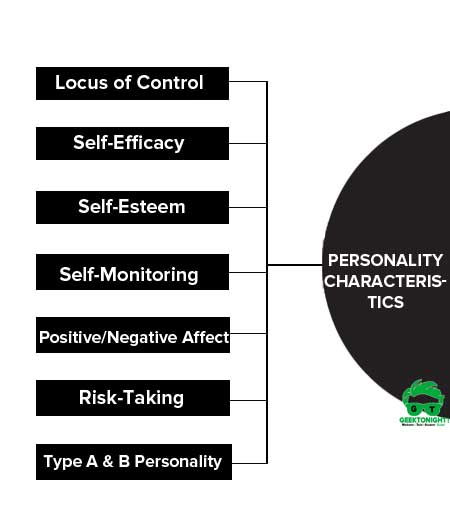
7 personality characteristics that influence individual are:
- Locus of Command
- Self-Efficacy
- Self-Esteem
- Self-Monitoring
- Positive/Negative Impact
- Risk-Taking
- Blazon A and Type B Personality
Locus of Control
The caste to which individuals perceive control over a state of affairs being internal or external is called locus of command.
Locus of control refers to the range of behavior that individuals hold in terms of being controlled past self (internal locus) or controlled by others or the situation (external locus).
Self-Efficacy
Generalized self-efficacy refers to a belief almost 1's own ability to deal with events and challenges.
Loftier self-efficacy results in greater conviction in one'due south chore-related abilities to function effectively on the job. Success in previous situations leads to increased cocky-efficacy for present and hereafter challenges.
Cocky-Esteem
An individual'due south cocky-worth is referred to as self-esteem. Individuals with high self-esteem have positive feelings about themselves.
Low self-esteem individuals are strongly affected by what others think of them, and view themselves negatively.
Self-Monitoring
The extent to which people base of operations their behavior on cues from other people and situations is cocky-monitoring.
Individuals loftier in self-monitoring pay attending to what behavior is advisable in sure situations past watching others and behaving appropriately.
Low self-monitoring individuals prefer that their behavior reflects their attitudes, and are not as flexible in adapting their behavior to situational cues.
Positive/Negative Touch
Individuals exhibit attitudes about situations in a positive or negative fashion.
An individual'due south tendency to accentuate the positive aspects of situations is referred to equally positive affect, while those accentuating less optimistic views are referred to as having negative affect.
Employees with positive bear on are absent-minded from piece of work less often. Negative affect individuals report higher levels of job stress.
Gamble-Taking
People differ in their willingness to take chances. High-take a chance-taking managers made more rapid decisions and used less information in making their choices than low risk-taking managers.
Type A and Type B Personality
Type A personality individual is aggressively involved in a chronic, struggle to achieve more and more in less and less time, and if required to do and then, against the opposing efforts of other things or other persons.
Type B personalities are rarely harried past the desire to obtain a wildly increasing number of things or participate in an endless growing series of events in an ever decreasing corporeality of time.
Theories of Personality
Over time, researchers accept developed a number of personality theories and no theory is consummate in itself.
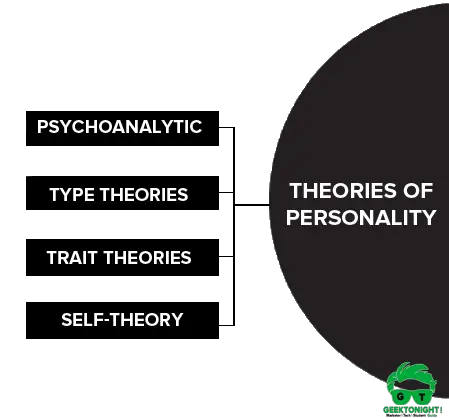
The theories of personality can be conveniently grouped nether four types:
1. Psychoanalytic Theory
ii. Blazon Theories
3. Trait Theories
4. Cocky-theory
Psychoanalytic Theory
The Psychoanalytic Theory of personality has held the interest of psychologists and psychiatrists for a long fourth dimension. Sigmund Freud, its formulator, was quite an influence.
Information technology attends to emphasizes 3 principal bug i.eastward. the id, the ego and the superego . Psychoanalysts say that all human being personality is comprised of these closely integrated functions.
Type Theories
The type theories represent an attempt to put some caste of gild into the chaos of personality theory. The type theory represents an attempt to scientifically draw personality by classifying individuals into user-friendly categories.
Two categories of type theories are explained below:
Sheldon'south Physiognomy Theory: William Sheldon has presented a unique body-blazon temperamental model that represents a link between certain anatomical features and psychological traits with distinguishing characteristics of an individual and his behaviour.
Carl Jung'due south Extrovert-introvert Theory: The way to blazon personality is in terms of behavior or psychological factors. Jung'south introvert and extrovert types are an example.
Trait Theories
Some early personality researchers believed that to understand individuals, we must break down behaviour patterns into a series of observable traits.
According to trait theory , combining these traits into a group forms an individual's personality. A personality trait tin exist divers every bit an "indelible attribute of a person that appears consistently in a variety of situations". In combination, such traits distinguish ane personality from another.
Gordon Allport's Personality Traits: Claims that personality traits are real entities, physically located somewhere in the encephalon. We each inherit our own unique set of raw material for given traits, which are then shaped by our experiences.
Raymond Cattell'due south 16 Personality Factors: Raymond Cattell considered personality to be a pattern of traits providing the key to understanding and predicting a person's behaviour.
Cattell identified two types:
- Surface Traits
- Source Traits
Self-theory
The psychoanalytic, blazon and trait theories represent the more traditional approach to explaining the complex man personality.
Carl Rogers is well-nigh closely associated with his approach of self-theory. Rogers and his associates have developed this personality theory that places accent on the private as an initiating, creating, influential determinant of behaviour inside the environmental framework.
According to Rogers basic ingredients of personality:
- Self Actualization: Carl Rogers believed that humans have one basic motive that is the tendency to cocky-concretize – i.due east. to fulfil one'southward potential and achieve the highest level of 'human-beingness' we can.
- Self-concept: Self-concept is divers every bit "the organized, consequent set of perceptions and behavior about oneself".
As well Read: Theories of Personality
Nature of Personality
Personality is the psychological growth and development within the ambit of change.
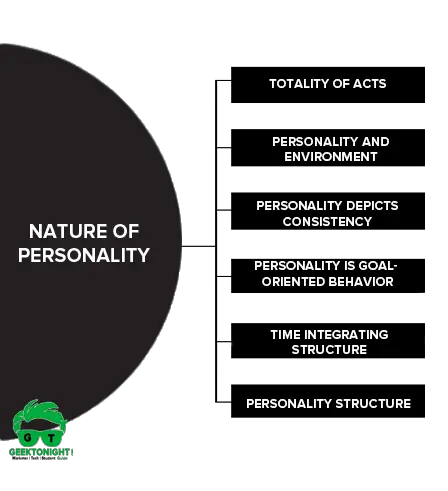
Hubert Bonner underlines half-dozen propositions to clarify the nature of personality. These propositions are relevant to decision making by an administrator.
- Totality of acts
- Personality and Surround
- Personality Depicts consistency
- Personality is goal-oriented beliefs
- Fourth dimension Integrating structure
- Personality Structure
Totality of Acts
In an system, human behaviour is the betoken of culmination which is preceded by a number of acts. It is the totality of these acts in the form of responded behaviour which is relevant to both individual and the system. The isolated psychological or physiological aspect of individual in personality is of no utilize for administrative decision or activeness.
Personality and Environment
Personality and environs are two interdependent variables of human behaviour. Personality gets molded according to the environment, it is also a fact that it is the surroundings which stimulates personality to action.
Personality Depicts consistency
Normal personality is dynamic due to the ecology setting effectually him. Personality can exist flexible to the point of consistency in a different environmental setting.
Personality is goal-oriented behavior
Every private seeks to achieve the desired goal through his personality. The process of goal pick is in itself a dynamic quality of personality which also forges unity between personality and goal-directed behaviour.
Time Integrating construction
Personality provides a synthesis of the retrospect and the prospect because the future is as much related to past every bit the past is to future.
Personality Structure
Personality structure consists of 3 dimensions – determinants, stages and traits.
Too Read: What is Learning?
Brand Personality
Nosotros can carve up or written report the personality of a brand in five dimensions:
- Sincerity of the brand
- Excitement
- Competence
- Sophisticated
- Rugged
Sincerity of the brand
The image of the brand as existence down to globe, very honest and cheerful. Brands that are sincere always fulfill their promises. Consumers do get the desired benefits out of them.
Some brands like Raymond and Hero Honda Passion are viewed as sincere make equally people trust these brands and they never disappoint the consumers.
Excitement
At that place are some brands that prove their image every bit being daring, imaginative and spirited. These brands target adventurous people, people with hedonic motives and people who desire to experiment.
Brands similar Mount Dew and Bajaj Pulsar are related to this personality type where people are shown doing amazing stunts that pump excitement in consumers.
Competence
These are the types that are reliable, intelligent and successful. These brands are most trusted and they have an association with the consumers. They are said to be very consumer-oriented and they know what their consumers want. They are promoted in such a way that their core competencies and success story come out in between the consumers.
Example: Airtel and LIC of India are reliable and they are successful also.
Sophisticated
These brands accept an upper-grade feeling attached to them. They are charming and everyone dreams of owning such brands. These brands have an prototype that is classy and glamorous.
Brands such equally Mercedes and Tommy Hilfiger are considered every bit upmarket and charming.
Rugged
These are the make which take a very western and masculine image. They are considered to be tough and outdoorsy. They are connected with men or in some cases women, with
Personality in Consumer Behaviour
Harold H Kassarjian and Mary Jane Sheffet reviewed more than 300 studies on personality and have ended that the results are "equivocal." Few studies seem to show a definite relationship betwixt consumers' personality and behaviour, other studies are indicative of no relationship.
The bulk of studies indicate that if at all there is any relationship between personality and behaviour, information technology is too weak to have whatsoever practical value to marketers.
Sure types of personality traits may be more related to consumer behaviour than others, such as
- Optimal Stimulation Level (OSL)
- Need for Cognition (NFC)
- Dogmatism
- Susceptibility to influence
- Self-monitoring behaviour
Optimal Stimulation Level
Some activities accept more potential to provide individuals with some sort of physiological arousal. In that location are others who prefer a calm, simple and uncluttered life, while some others prefer novel, circuitous, exciting existence.
Inquiry in this expanse indicates that high optimum stimulation levels are associated with more than willingness to take risks; to be innovative, try new products and actively seek purchase-related information.
Need for Knowledge
Need for knowledge refers to the degree of an private'south want to think and savor getting engaged in information processing. Such individuals tend to seek information that requires thinking. Opposite to this would be those who shy away from such information and focus on peripheral information (ELM model).
For instance, a consumer high in need for cognition (NC) and looking at an advert for Apple computer is more likely to study and concentrate on the information independent in the advert.
On the other manus, a consumer low in need for cognition would be more than inclined to look at the beautiful moving picture of iMac, ignoring the detailed information virtually the computer model.
Dogmatism
Consumers are as well likely to vary in terms of how open-minded or closed-minded they are . Dogmatism is a personality trait that indicates the degree of an individual's rigidity toward anything that is reverse to her/his own established beliefs.
Plainly, the person is resistant to alter and new ideas. One would look highly dogmatic consumers to be relatively resistant to new products, promotions or advertising.
Susceptibility to Influence
Consumers differ in terms of their proneness to persuasion attempts by others, especially when these attempts happen to be interpersonal or face-to-face.
Consumers with lower social and data processing confidence bear witness more proneness to be influenced by ads compared to those who take higher cocky-confidence.
Cocky-monitoring Behaviour
Individual consumers differ in the caste to which they look to others for indications on how to behave. Those persons who are high-self monitors tend to look to others for management and accordingly guide their own behaviour. They are more sensitive and responsive to paradigm-oriented ads and willing to try such products. They are less likely to be consumer innovators.
On the other hand, individuals who are low self-monitors are guided past their own preferences or standards and are less likely to be influenced by others expectations. They pay more attention to advertizing letters that focus on product features, quality and benefits. Furthermore, they are besides likely to try and pay extra for these products and are consumer innovators.
Reference
- Robbins, Stephen P. 2010. Organizational Behaviour. New Delhi: Prentice-Hall.
- Fred Luthans, Organisational Behaviour, McGraw Hill Book Co., 1995.
- Keith Davis, Man Behaviour at Wor/c,.-M.McGraw Hill Book Co., 1991.
- Cattell R.B. "Personality Pinned Downwards", Psychology Today, July 1973.
FAQ
Keep, Share & Help your Friend
Did nosotros miss something in Organizational Behavior Tutorial or You want something More than? Come on! Tell us what y'all think most our mail on Personality Characteristics, Determinants | Organisational Beliefs in the comments section and Share this post with your friends.

Source: https://www.geektonight.com/personality-in-organisational-behavior-definition-determinants-nature/
0 Response to "what do personality theorists seek to accomplish in their role of scientists?"
Post a Comment